This is for the BL~ Butterfly profile deco ლ Oct.
Ann AKA Trader1244
I chose the Papilio aristodemus, the Schaus' swallowtail or island swallowtail, is a species of American butterfly in the family Papilionidae. It is found in southern Florida with subspecies in the Bahamas, Hispaniola, and Cuba. Historically it occurred in tropical hardwood hammock from South Miami to Lower Matecumbe Key, Florida. It is named in honor of William Schaus.
The Schaus' swallowtail has black-brown wings with yellow markings and a broad rusty patch underneath the hindwing.[4] The male's antennae are black with a yellow knob, while the female's antennae are all black. Their forewings have a dull yellow median band from the apex to about midpoint of the inner margin, with a short side branch to costa about one-third the distance from the apex.
Meet Acherontia atropos, otherwise known as the death's-head hawkmoth. It gets its name from the sinister-looking skull shape on its back. In many cultures, it is thought to be an omen of death. It was famously featured in the Hannibal Lecter film The Silence of the Lambs, and appears on the poster. It was famously featured in the Hannibal Lecter film The Silence of the Lambs, and appears on the poster. Death's-head hawkmoths mostly eat honey by entering the hives of honeybees. To avoid stings, the moths produce a chemical that soothes the bees.
I hope you like the pics and gif that I've chosen for you!
I've chosen the Monarch Butterfly to share with you. It is also called "Danaus plexippus). It is in the family "Nymphalidae" and the subfamily "Danainae"
Identification: Upperside of male is bright orange with wide black borders and black veins; hindwing has a patch of scent scales. Upperside of female is orange-brown with wide black borders and blurred black veins. Both sexes have white spots on borders and apex. The Viceroy butterfly (Limenitis archippus) is a Mullerian mimic; it has similar coloration and is also distasteful.
Wing Span: 3 3/8 - 4 7/8 inches (8.6 - 12.4 cm).
Life History: Adults warm up by basking dorsally (with their wings open and toward the sun). Females lay eggs singly under the host leaves; caterpillars eat leaves and flowers. Adults make massive migrations from August-October, flying thousands of miles south to hibernate along the California coast and in central Mexico. A few overwinter along the Gulf coast or south Atlantic coast. Along the way, Monarchs stop to feed on flower nectar and to roost together at night. At the Mexico wintering sites, butterflies roost in trees and form huge aggregations that may have millions of individuals. During the winter the butterflies may take moisture and flower nectar during warm days. Most have mated before they leave for the north in the spring, and females lay eggs along the way. Residents of tropical areas do not migrate but appear to make altitude changes during the dry season.
Flight: In North America during spring and summer there may be 1-3 broods in the north and 4-6 broods in the south. May breed all year in Florida, South Texas, and southeastern California.
Caterpillar Hosts: Milkweeds including common milkweed (Asclepias syriaca), swamp milkweed (A. incarnata), and showy milkweed (A. speciosa); and milkweed vine in the tropics. Most milkweeds contain cardiac glycosides which are stored in the bodies of both the caterpillar and adult. These poisons are distasteful and emetic to birds and other vertebrate predators. After tasting a Monarch, a predator might associate the bright warning colors of the adult or caterpillar with an unpleasant meal, and avoid Monarchs in the future.
Adult Food: Nectar from all milkweeds. Early in the season before milkweeds bloom, Monarchs visit a variety of flowers including dogbane, lilac, red clover, lantana, and thistles. In the fall adults visit composites including goldenrods, blazing stars, ironweed, and tickseed sunflower.
Habitat: Many open habitats including fields, meadows, weedy areas, marshes, and roadsides.
Range: Southern Canada south through all of the United States, Central America, and most of South America. Also present in Australia, Hawaii, and other Pacific Islands.
Conservation: Overwintering sites in California and Mexico should be protected and conserved.
Monarch butterfly life cycle.
Monarch caterpillar
Closeup of the Monarch butterfly's head. I thought this picture was amazing.
This Blushing Phantom Butterfly - Cithaerias pireta is also referred to as Clearwing/Glasswing Buttertfly. They probably got the Blushing name from the pink tips on the hind wings.
Cithaerias pireta can be found from Mexico to South America with several sub-species found in Colombia, Perua and Brazil. (info from: https://www.jungledragon.com/image/43587/blushingphantombutterfly-cithaerias_pireta.html)
BL~ Butterfly profile deco ლ Oct.
XERCES BLUE
The Xerces blue (Glaucopsyche xerces) is an extinct species of butterfly in the gossamer-winged butterfly family, Lycaenidae. The species lived in coastal sand dunes of the Sunset District of San Francisco.
The Xerces blue is believed to be the first American butterfly species to become extinct as a result of loss of habitat caused by urban development. The last Xerces blue was seen in 1941 or 1943 on land that is part of Golden Gate National Recreation Area.
LINK TO EXTINCTION DIARIES SHORT VIDEO ON BLUE XERCES
Specimens in California Academy of Sciences.
The species was first described and documented in 1852. It was characterized by blue wings with white spots. The butterfly's food plants belonged to the genera Lotus and Lupinus. Xerces probably associated with ants in its larval stages as part of a symbiotic relationship. One of the theories regarding the extinction of the species is that with human settlement in the Bay Area, new species of ant were introduced which slowly replaced the existing ant species within the butterfly's super habitat.
Efforts are on to reestablish related butterflies in the Xerces blue's former habitat. The Palos Verdes blue (Glaucopsyche lygdamus palosverdesensis)
which is considered a Los Angeles cousin of the Xerces, is being reared in labs. A new Xerces-like subspecies of the silvery blue (Glaucopsyche lygdamus) has been discovered as well.
In popular culture...
The Xerces blue butterfly was shown and referenced in The 4400 episode "Ghost in the Machine" when it was brought back from extinction. This was due to a superhuman ability given by the fictional drug "Promicin". In The 4400, Xerces blues where thriving at the beginning of the utopian community Promise City. The Sacramento band Deftones released a song called "Xerces" on their 2006 album Saturday Night Wrist. Also there is a Xerces blue in a Silent Hill's memento called Pinned Beauty.
I HOPE YOU ENJOYED this info & pics!
Blessings, cc
Reflect on this
The symbol of the Midlands Meander – the rare and endangered Karkloof Blue Butterfly (Orachrysops ariadne) is known in only three locations in KwaZulu Natal. Dependent on moist mist-belt grassland, this butterfly has a unique relationship with the sugar ant which carries the larva from the nest to the food source:



Page 8 of paperfilia's Comments
Back to paperfilia's profile
Decorate Your Partners Profile For Halloween
When black cats prowl
and pumpkins gleam
May luck be yours
on Halloween
One of my favorite things about Halloween is all of the great images of black cats. Happy Halloween!!
Dear partner,
I hope you’ll enjoy the pictures I’ve picked! Please don’t forget to rate. Happy swapping!
Decorate Your Partners Profile For Halloween
~~HAPPY HALLOWEEN~~
From Decorate Your Partner's Profile for Halloween Swap
Hold on, man. We don't go anywhere with "scary," "spooky," "haunted," or "forbidden" in the title. ~From Scooby-Doo
Decorate Your Partners Profile For Halloween Swap - JoteKB
This is for the BL~ Butterfly profile deco ლ Oct.
Ann AKA Trader1244
I chose the Papilio aristodemus, the Schaus' swallowtail or island swallowtail, is a species of American butterfly in the family Papilionidae. It is found in southern Florida with subspecies in the Bahamas, Hispaniola, and Cuba. Historically it occurred in tropical hardwood hammock from South Miami to Lower Matecumbe Key, Florida. It is named in honor of William Schaus.
The Schaus' swallowtail has black-brown wings with yellow markings and a broad rusty patch underneath the hindwing.[4] The male's antennae are black with a yellow knob, while the female's antennae are all black. Their forewings have a dull yellow median band from the apex to about midpoint of the inner margin, with a short side branch to costa about one-third the distance from the apex.
Death's Head Hawkmoth
Meet Acherontia atropos, otherwise known as the death's-head hawkmoth. It gets its name from the sinister-looking skull shape on its back. In many cultures, it is thought to be an omen of death. It was famously featured in the Hannibal Lecter film The Silence of the Lambs, and appears on the poster. It was famously featured in the Hannibal Lecter film The Silence of the Lambs, and appears on the poster. Death's-head hawkmoths mostly eat honey by entering the hives of honeybees. To avoid stings, the moths produce a chemical that soothes the bees.
BL~ Butterfly profile deco ლ Oct.
I hope you like the pics and gif that I've chosen for you!
I've chosen the Monarch Butterfly to share with you. It is also called "Danaus plexippus). It is in the family "Nymphalidae" and the subfamily "Danainae"
Identification: Upperside of male is bright orange with wide black borders and black veins; hindwing has a patch of scent scales. Upperside of female is orange-brown with wide black borders and blurred black veins. Both sexes have white spots on borders and apex. The Viceroy butterfly (Limenitis archippus) is a Mullerian mimic; it has similar coloration and is also distasteful.
Wing Span: 3 3/8 - 4 7/8 inches (8.6 - 12.4 cm).
Life History: Adults warm up by basking dorsally (with their wings open and toward the sun). Females lay eggs singly under the host leaves; caterpillars eat leaves and flowers. Adults make massive migrations from August-October, flying thousands of miles south to hibernate along the California coast and in central Mexico. A few overwinter along the Gulf coast or south Atlantic coast. Along the way, Monarchs stop to feed on flower nectar and to roost together at night. At the Mexico wintering sites, butterflies roost in trees and form huge aggregations that may have millions of individuals. During the winter the butterflies may take moisture and flower nectar during warm days. Most have mated before they leave for the north in the spring, and females lay eggs along the way. Residents of tropical areas do not migrate but appear to make altitude changes during the dry season.
Flight: In North America during spring and summer there may be 1-3 broods in the north and 4-6 broods in the south. May breed all year in Florida, South Texas, and southeastern California.
Caterpillar Hosts: Milkweeds including common milkweed (Asclepias syriaca), swamp milkweed (A. incarnata), and showy milkweed (A. speciosa); and milkweed vine in the tropics. Most milkweeds contain cardiac glycosides which are stored in the bodies of both the caterpillar and adult. These poisons are distasteful and emetic to birds and other vertebrate predators. After tasting a Monarch, a predator might associate the bright warning colors of the adult or caterpillar with an unpleasant meal, and avoid Monarchs in the future.
Adult Food: Nectar from all milkweeds. Early in the season before milkweeds bloom, Monarchs visit a variety of flowers including dogbane, lilac, red clover, lantana, and thistles. In the fall adults visit composites including goldenrods, blazing stars, ironweed, and tickseed sunflower.
Habitat: Many open habitats including fields, meadows, weedy areas, marshes, and roadsides.
Range: Southern Canada south through all of the United States, Central America, and most of South America. Also present in Australia, Hawaii, and other Pacific Islands.
Conservation: Overwintering sites in California and Mexico should be protected and conserved.
Monarch butterfly life cycle.
Monarch caterpillar
Closeup of the Monarch butterfly's head. I thought this picture was amazing.
Enjoy!
Blessings,
Yvonne
BL~ Butterfly profile deco ლ Oct.
The Blushing Phantom
This Blushing Phantom Butterfly - Cithaerias pireta is also referred to as Clearwing/Glasswing Buttertfly. They probably got the Blushing name from the pink tips on the hind wings. Cithaerias pireta can be found from Mexico to South America with several sub-species found in Colombia, Perua and Brazil. (info from: https://www.jungledragon.com/image/43587/blushingphantombutterfly-cithaerias_pireta.html)
Hope you like it! MichelleGG
BL~ Butterfly profile deco ლ Oct.
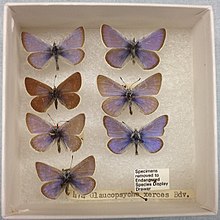
XERCES BLUE
The Xerces blue (Glaucopsyche xerces) is an extinct species of butterfly in the gossamer-winged butterfly family, Lycaenidae. The species lived in coastal sand dunes of the Sunset District of San Francisco.
The Xerces blue is believed to be the first American butterfly species to become extinct as a result of loss of habitat caused by urban development. The last Xerces blue was seen in 1941 or 1943 on land that is part of Golden Gate National Recreation Area. LINK TO EXTINCTION DIARIES SHORT VIDEO ON BLUE XERCES

Specimens in California Academy of Sciences.
The species was first described and documented in 1852. It was characterized by blue wings with white spots. The butterfly's food plants belonged to the genera Lotus and Lupinus. Xerces probably associated with ants in its larval stages as part of a symbiotic relationship. One of the theories regarding the extinction of the species is that with human settlement in the Bay Area, new species of ant were introduced which slowly replaced the existing ant species within the butterfly's super habitat.
Efforts are on to reestablish related butterflies in the Xerces blue's former habitat. The Palos Verdes blue (Glaucopsyche lygdamus palosverdesensis)

which is considered a Los Angeles cousin of the Xerces, is being reared in labs. A new Xerces-like subspecies of the silvery blue (Glaucopsyche lygdamus) has been discovered as well.
In popular culture...
The Xerces blue butterfly was shown and referenced in The 4400 episode "Ghost in the Machine" when it was brought back from extinction. This was due to a superhuman ability given by the fictional drug "Promicin". In The 4400, Xerces blues where thriving at the beginning of the utopian community Promise City. The Sacramento band Deftones released a song called "Xerces" on their 2006 album Saturday Night Wrist. Also there is a Xerces blue in a Silent Hill's memento called Pinned Beauty.
I HOPE YOU ENJOYED this info & pics!
Blessings, cc
Reflect on this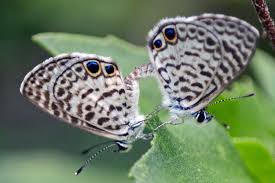
 The symbol of the Midlands Meander – the rare and endangered Karkloof Blue Butterfly (Orachrysops ariadne) is known in only three locations in KwaZulu Natal. Dependent on moist mist-belt grassland, this butterfly has a unique relationship with the sugar ant which carries the larva from the nest to the food source:
